
Nefrofix Tablets
Safeguard Kidneys. Support Life.
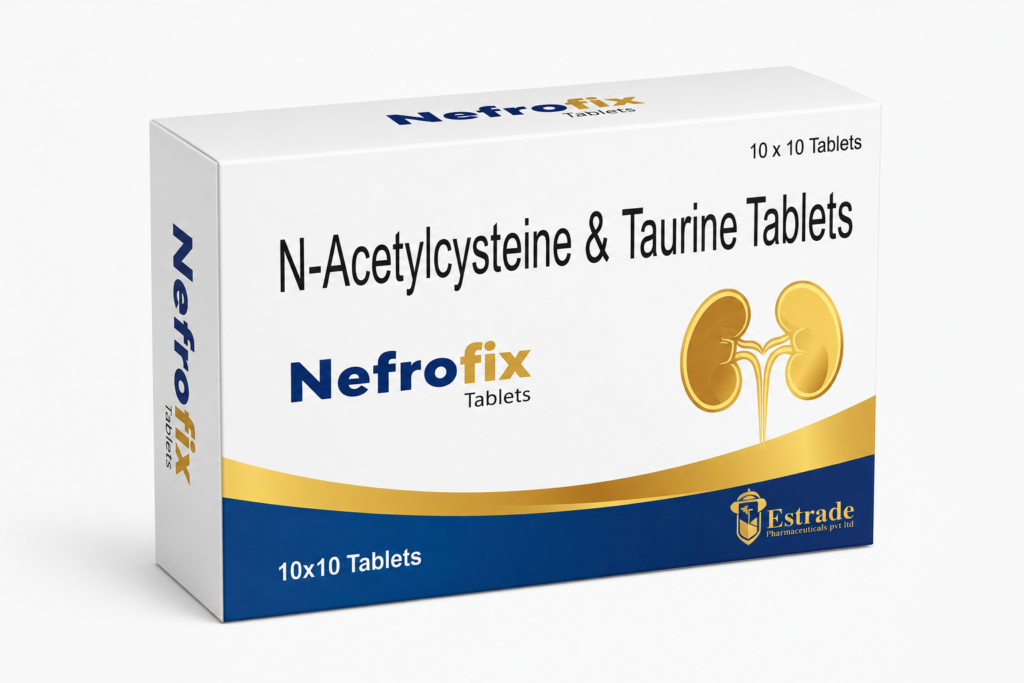
The Powerful Duo for Renal Protection
Nefrofix Summary Table
| Parameter | Details |
|---|---|
| Brand Name | Nefrofix |
| Composition | N-Acetylcysteine 150 mg + Taurine 500 mg |
| Dosage Form | Tablet |
| Therapeutic Class | Renal antioxidant and nephroprotective supplement |
| Mechanism of Action | Antioxidant activity, glutathione enhancement, membrane stabilization, osmoregulation |
| Primary Actions | Renal protection, oxidative stress reduction, electrolyte balance support |
| Indications | CKD, diabetic nephropathy, post-contrast nephropathy, nephrotoxicity, renal debility |
| Recommended Dose | 1 tablet once or twice daily or as directed |
| Common Side Effects | Generally well tolerated; occasional mild gastrointestinal discomfort |
| Storage | Store below 30°C, protected from moisture and light |
| Key Advantages | Dual-action renal support, antioxidant protection, tissue repair, membrane stabilization |
| Pack Presentation | 10 × 10 Tablets (Alu-Alu) |
Product Summary
Nefrofix is a synergistic combination of N-Acetylcysteine (150 mg) and Taurine (500 mg) formulated to provide comprehensive antioxidant and cytoprotective support for renal health. By targeting oxidative stress, supporting glutathione synthesis, maintaining osmotic balance, and preserving cellular integrity, Nefrofix helps protect renal tissue and supports overall kidney function (Rushworth & Megson, 2014; Schaffer et al., 2010).
The combination is useful as supportive therapy in patients with chronic kidney disease, diabetic nephropathy, drug-induced nephrotoxicity, post-contrast nephropathy, and other conditions associated with oxidative stress and renal impairment.
Composition
| Ingredient | Strength | Role |
|---|---|---|
| N-Acetylcysteine | 150 mg | Antioxidant, glutathione precursor, detoxification support |
| Taurine | 500 mg | Membrane stabilizer, osmoregulator, renal protective amino acid |
| Excipients | q.s. | Pharmaceutical excipients |
Dual Action – Superior Renal Protection
N-Acetylcysteine (NAC)
- Potent antioxidant and free radical scavenger
- Enhances intracellular glutathione synthesis
- Reduces oxidative stress-mediated renal injury
- Supports tissue repair and detoxification
- Protects renal tubular cells from oxidative damage
Taurine
- Amino sulfonic acid with antioxidant properties
- Maintains cellular membrane stability
- Regulates osmotic pressure and electrolyte balance
- Supports renal hemodynamics and filtration
- Helps preserve normal kidney function
Together – Protects. Supports. Preserves.
Mechanism of Action
N-Acetylcysteine
N-Acetylcysteine acts as a precursor to glutathione, one of the body’s major endogenous antioxidants. It neutralizes reactive oxygen species, reduces oxidative injury, and supports cellular repair mechanisms, thereby protecting kidney tissue from oxidative damage (Rushworth & Megson, 2014).
Taurine
Taurine exerts antioxidant, anti-inflammatory, and osmoregulatory actions. It stabilizes cell membranes, improves electrolyte homeostasis, and supports renal blood flow and filtration, contributing to preservation of kidney structure and function (Schaffer et al., 2010).
Indications
Nefrofix is recommended for supportive management in:
- Chronic Kidney Disease (CKD)
- Diabetic nephropathy
- Drug-induced nephrotoxicity
- Post-contrast nephropathy
- Recurrent urinary tract infections
- General renal debility
- Oxidative stress-associated renal dysfunction
Key Benefits
Antioxidant Protection
- Helps combat oxidative stress and free radical injury
Supports Renal Health
- Assists in maintaining normal kidney function
Electrolyte & Fluid Balance
- Supports osmoregulation and electrolyte homeostasis
Detoxification & Tissue Repair
- Enhances glutathione levels and promotes tissue recovery
Cellular Protection
- Preserves membrane integrity and renal cell viability
Dosage & Administration
Adults:
1 tablet once or twice daily, or as directed by the physician.
Storage
Store below 30°C in a cool, dry place protected from moisture and sunlight.
Keep out of reach of children.
Pack Presentation
- 10 × 10 Tablets (Alu-Alu)
- Tamper-proof blister packaging
- Attractive unit carton
- Clear and convenient labeling
Recommended In
- Chronic Kidney Disease (CKD)
- Diabetic Nephropathy
- Drug-induced Nephrotoxicity
- Post-contrast Nephropathy
- Recurrent Urinary Tract Infections
- General Renal Debility
Key Advantages
- Dual antioxidant and cytoprotective mechanism
- Supports glutathione synthesis and renal tissue repair
- Maintains fluid and electrolyte balance
- Helps preserve renal function under oxidative stress
- Ideal adjunctive support in various renal disorders
References (APA 7)
Rushworth, G. F., & Megson, I. L. (2014). Existing and potential therapeutic uses for N-acetylcysteine: The need for conversion to intracellular glutathione for antioxidant benefits. Pharmacology & Therapeutics, 141(2), 150–159. https://doi.org/10.1016/j.pharmthera.2013.09.006
Schaffer, S. W., Jong, C. J., Ramila, K. C., & Azuma, J. (2010). Physiological roles of taurine in heart and muscle. Journal of Biomedical Science, 17(Suppl 1), S2. https://doi.org/10.1186/1423-0127-17-S1-S2
Xu, Y. J., Arneja, A. S., Tappia, P. S., & Dhalla, N. S. (2008). The potential health benefits of taurine in cardiovascular disease. Experimental & Clinical Cardiology, 13(2), 57–65. https://www.ncbi.nlm.nih.gov/pmc/articles/PMC2712098/
Kelly, A. M. (1998). Delineation of the chemical and biological properties of a novel antioxidant, N-acetylcysteine. American Journal of Medicine, 105(1A), 26S–31S. https://doi.org/10.1016/S0002-9343(98)00147-7
Briguori, C., Visconti, G., Rivera, N. V., et al. (2011). Cysteine and contrast-induced acute kidney injury. Circulation, 124(11), 1250–1259. https://doi.org/10.1161/CIRCULATIONAHA.111.038943