
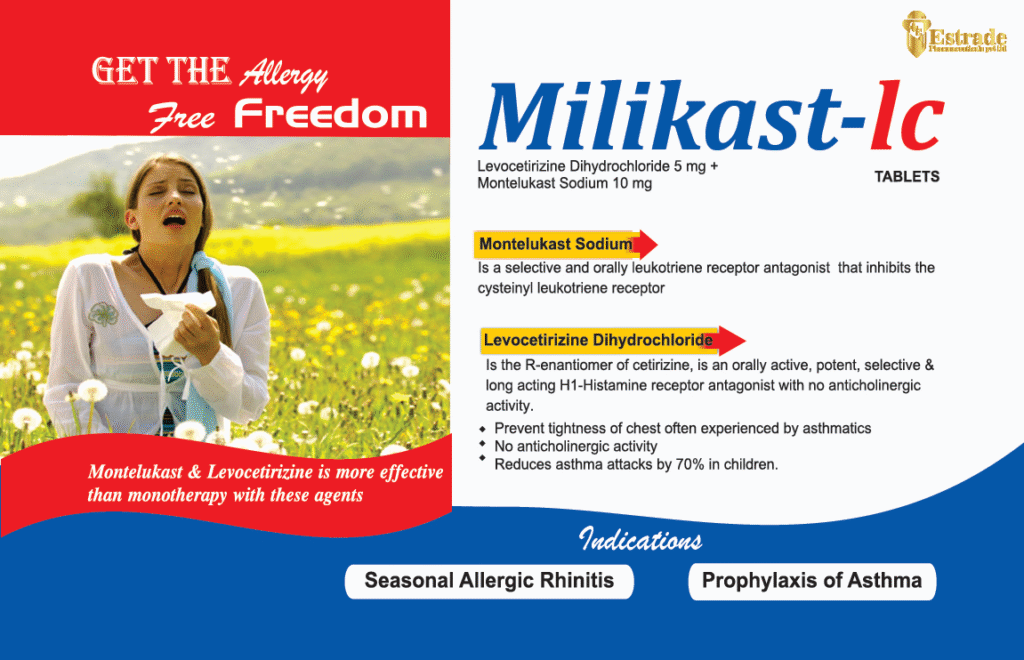
GET THE Allergy-Free FREEDOM
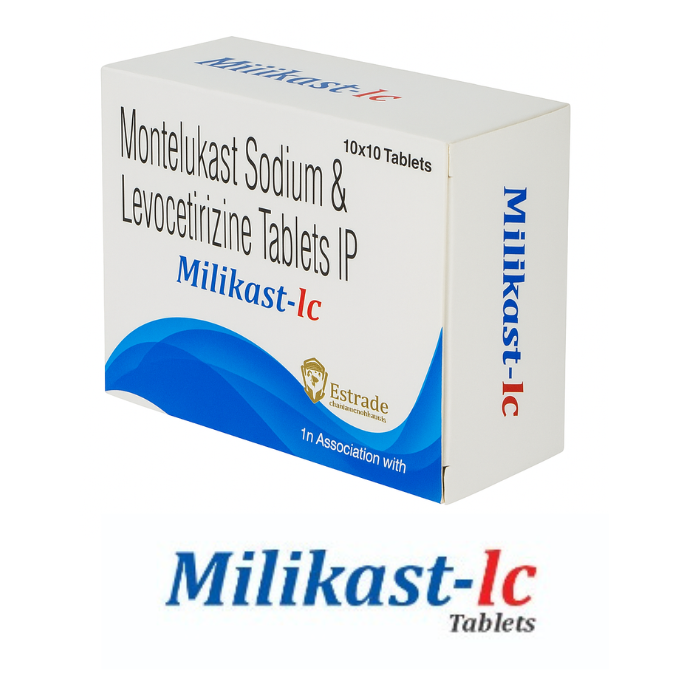
Mlikast-LC Summary Table
| Parameter | Details |
|---|---|
| Brand name | Mlikast-LC |
| Composition | Levocetirizine Dihydrochloride 5 mg + Montelukast Sodium 10 mg |
| Dosage form | Film-coated tablet |
| Pharmacological class | Dual anti-allergic agent — H₁ antihistamine + Leukotriene receptor antagonist |
| Mechanism of action | Levocetirizine: Selective H₁-receptor blocker that inhibits histamine-mediated symptoms. Montelukast: CysLT₁ receptor antagonist that blocks leukotriene-induced bronchoconstriction and inflammation. |
| Therapeutic rationale | Combination therapy provides greater relief of nasal, ocular, and airway symptoms than either monotherapy by targeting both histaminergic and leukotriene pathways. |
| Indications | • Seasonal & perennial allergic rhinitis • Prophylaxis of asthma in allergic patients • Nasal & respiratory allergic conditions |
| Recommended dose | One tablet once daily (adults / ≥12 yrs) or as directed by physician |
| Onset / duration | Symptom relief typically within 1 hour; 24-hour duration of action |
| Contraindications | Hypersensitivity to montelukast, levocetirizine, or related compounds; acute asthma attacks |
| Common adverse effects | Headache, mild drowsiness, dry mouth, gastrointestinal discomfort |
| Rare adverse effects | Neuropsychiatric events (insomnia, mood change), hypersensitivity reactions |
| Drug interactions | Separate from antacids by ~2 hours; review concomitant CNS depressants or hepatically-metabolized drugs |
| Special precautions | Not for acute bronchospasm; monitor neuropsychiatric symptoms; use with caution in renal/hepatic impairment |
| Storage | Store below 25 °C, dry and protected from light and moisture |
| Key advantages | • Dual-pathway control (histamine + leukotriene) • Proven efficacy vs monotherapy (Kim et al., 2024; Karger meta-analysis, 2025) • Minimal sedation • Once-daily dosing enhances adherence |
| Clinical evidence grade | Supported by randomized controlled trials, meta-analysis, and post-marketing studies (Level I-II evidence) |
Levocetirizine Dihydrochloride 5 mg + Montelukast Sodium 10 mg — Tablets
Product summary
Mlikast-LC is a once-daily fixed-dose combination tablet that pairs levocetirizine (a potent, long-acting R-enantiomer H₁-antihistamine) with montelukast (a selective oral cysteinyl-leukotriene receptor antagonist). The combination provides complementary mechanisms—rapid antihistaminic relief of nasal/ocular symptoms and leukotriene-mediated anti-inflammatory control of lower airway and nasal inflammation—leading to superior symptom control versus monotherapy in multiple randomized trials and meta-analyses (Kim et al., 2024; Kim, 2025). Indicated for seasonal allergic rhinitis and as prophylaxis in patients with allergic rhinitis and coexisting asthma, Mlikast-LC aims to reduce symptom burden and lower the risk of asthma exacerbations when used under physician supervision.
Composition (per tablet)
- Levocetirizine Dihydrochloride — 5 mg
- Montelukast Sodium — 10 mg
Pharmacology & mechanism of action
Montelukast — Montelukast selectively antagonizes the cysteinyl-leukotriene receptor (CysLT₁), thereby inhibiting leukotriene-mediated bronchoconstriction, airway edema, and mucus secretion. It is an orally active leukotriene receptor antagonist used for maintenance therapy and prophylaxis in asthma and for allergic rhinitis adjunctive therapy (StatPearls, 2023; DrugBank, 2024).
Levocetirizine — Levocetirizine is the active R-enantiomer of cetirizine and functions as a potent, selective H₁-receptor antagonist with long duration of action. Compared with racemic cetirizine, levocetirizine demonstrates higher H₁-receptor affinity and clinical potency, with minimal anticholinergic effects and low central nervous system sedation at therapeutic doses (Gandon et al., 2002; DrugBank, 2024).
Rationale for combination — Allergic rhinitis and many allergic respiratory conditions are mediated by multiple pathways, principally histamine and leukotrienes. Combining a second-generation antihistamine with a leukotriene receptor antagonist targets both pathways, producing greater improvement in nasal symptoms, congestion and overall symptom scores than either agent alone (Kim et al., 2024; Kim, 2025; Karger meta-analysis, 2025).
Indications
- Seasonal allergic rhinitis (moderate to severe)
- Prophylaxis and adjunctive management in patients with allergic rhinitis and coexisting asthma (as part of comprehensive asthma management)
Clinical evidence (highlights)
- Randomized controlled trials and post-marketing studies report that montelukast + levocetirizine combination therapy produced greater reductions in daytime and nighttime nasal symptom scores (including congestion and rhinorrhea) compared with monotherapy (Kim et al., 2024; C. Kim et al., 2025).
- Meta-analytic evidence indicates the combination improves daytime symptoms, nasal congestion, and rhinorrhea with a favorable adverse-event profile relative to single-agent therapy (Karger meta-analysis, 2025).
- Observational studies and clinician surveys in regional settings support clinical utility and tolerability of the combination in pediatric and adult populations, though monitoring is recommended for rare neuropsychiatric or behavioural effects associated with montelukast (AIMDR post-marketing, 2021; Altaş et al., 2023).
Dosage & administration
- Adults & adolescents (≥12 years): One tablet once daily, with or without food, or as prescribed by the physician.
- Paediatrics (<12 years): Use only under physician guidance; dose/formulation should be determined by the treating clinician.
- Missed dose: If a dose is missed, take the next dose at the usual time; do not double up.
Contraindications
- Known hypersensitivity to levocetirizine, montelukast, or any excipients.
- Not intended for relief of acute bronchospasm or acute severe asthma exacerbations (montelukast is not a rescue medication) (StatPearls, 2023).
Warnings & precautions
- Not a rescue agent: Maintain access to short-acting bronchodilators for acute asthma symptoms.
- Neuropsychiatric events: Montelukast has been associated rarely with neuropsychiatric events (sleep disturbances, agitation, mood changes); monitor patients and counsel caregivers, especially in children and adolescents (Altaş et al., 2023; StatPearls, 2023).
- Renal/hepatic impairment: Use with caution if significant organ impairment is present; adjust therapy per clinical judgment.
- Drug interactions: Assess concomitant medications; avoid co-administration with agents that the treating physician identifies as problematic.
Adverse effects
Common adverse effects reported in trials and observational studies include headache, somnolence (rare with levocetirizine at therapeutic doses), dry mouth, and gastrointestinal discomfort. Combination therapy has not shown a consistent increase in adverse events compared with monotherapy in trials to date, but rare events (including hypersensitivity and neuropsychiatric symptoms) require vigilance (Kim et al., 2024; Karger meta-analysis, 2025).
Special populations
- Children: Several studies include pediatric cohorts showing symptom improvement and acceptable tolerability; dosing and monitoring should follow pediatric guidance from the prescribing clinician (AIMDR post-marketing, 2021).
- Pregnancy & lactation: Use only if clearly needed and after benefit-risk assessment by the treating physician.
Storage
Store in a cool, dry place below 25 °C. Protect from light and moisture. Keep out of reach of children.
Why choose Mlikast-LC?
- Complementary dual mechanism — antihistamine + leukotriene receptor antagonism to target both upper and lower airway allergic pathways.
- Evidence of superiority vs monotherapy — RCTs and systematic reviews report greater symptom relief with combination therapy (Kim et al., 2024; Karger meta-analysis, 2025).
- Formulation stability research supports viable fixed-dose combination tablet development for consistent delivery (Yun et al., 2024).
- Convenient once-daily dosing improves patient adherence.
Practical notes for prescribers
- Consider Mlikast-LC for patients with allergic rhinitis and coexisting lower-airway symptoms or those whose symptoms are not adequately controlled with single-agent therapy.
- Review patient history for prior neuropsychiatric events and counsel regarding potential rare side effects of montelukast.
- Maintain standard asthma action plans and rescue medications for patients with asthma.
References
Altaş, U., et al. (2023). Evaluation of neuropsychiatric effects of montelukast–levocetirizine combination therapy in children. [Article]. Retrieved October 21, 2025, from https://www.ncbi.nlm.nih.gov/pmc/articles/PMC10453715/
AIMDR Journal / Pawaskar, L. (2021). Efficacy and safety for the combination of montelukast and levocetirizine: post-marketing surveillance. AIMDR. Retrieved October 21, 2025, from https://aimdrjournal.com/wp-content/uploads/2021/08/10-17.-Lalit-Pawaskar-61-70.pdf
DrugBank. (2024). Levocetirizine (DB06282) — drug profile. Retrieved October 21, 2025, from https://go.drugbank.com/drugs/DB06282
DrugBank. (2024). Montelukast (DB00471) — drug profile. Retrieved October 21, 2025, from https://go.drugbank.com/drugs/DB00471
Gandon, J. M., et al. (2002). Lack of effect of single and repeated doses of levocetirizine on psychomotor performance and driving—study. International Journal of Clinical Pharmacology. Retrieved October 21, 2025, from https://www.ncbi.nlm.nih.gov/pmc/articles/PMC1874390/
Karger. (2025). Kim, J. S. (2025). Comparative efficacy of montelukast–levocetirizine combination versus monotherapy: systematic review and meta-analysis. International Archives of Allergy and Immunology. https://karger.com/iaa/article/doi/10.1159/000547410/930506
Kim, C. K., et al. (2024). Efficacy and safety of montelukast + levocetirizine in allergic rhinitis: randomized controlled study. Allergy, Asthma & Immunology Research, 16(6), 652–660. https://e-aair.org/DOIx.php?id=10.4168%2Faair.2024.16.6.652
StatPearls. (2023). Wermuth, H. R. Montelukast (StatPearls [Internet]). Retrieved October 21, 2025, from https://www.ncbi.nlm.nih.gov/books/NBK459301/
Yun, T. H., et al. (2024). Enhanced stability and compatibility of montelukast and levocetirizine for fixed-dose combination tablet development. Pharmaceutics, 16(7), 963. https://www.mdpi.com/1999-4923/16/7/963
Diamant, Z. (2009). Montelukast in the treatment of asthma and beyond. Expert Review of Clinical Immunology. (Background on montelukast mechanism.)